
We work to overcome exploitation in global supply chains and on the world’s oceans with stewardship.
Founded in 2012 in Honolulu, we help businesses and governments to produce goods and growth durably and with dignity.
Our clients are diverse and include the ASEAN group of 11 nations, Humanity United and the Freedom Fund, Whole Foods, UN-FAO, the Hawaii Tuna Fleet, SYMPAC and Fong Hsiang Enterprises, International Organization for Migration, governments of Indonesia and the Philippines, Thai Union and many others.
We succeed together by reconciling conflicting needs:
Livelihoods and environmental sustainability,
Economic efficiency and worker dignity,
Global markets and local communities.
Producers and buyers have different pressures. Workers and employers have different interests. Governments and industries have different responsibilities. None can sustain their interests without strong working relationships. That is where we come in.
We steward the system.
The Sustainability Incubator prepares practical research and methods to respond to crises in ungoverned spaces for clients trying to adapt, build new capacity, and shift the business model towards stability. We find shared objectives for people with competing interests and different stakes and investigate conditions to find the places and people most affected and ensure an effective response. We steward the system by helping businesses and governments to reset arrangements to match the local setting where impact lives.
Here is an example of our stewardship of seafood:
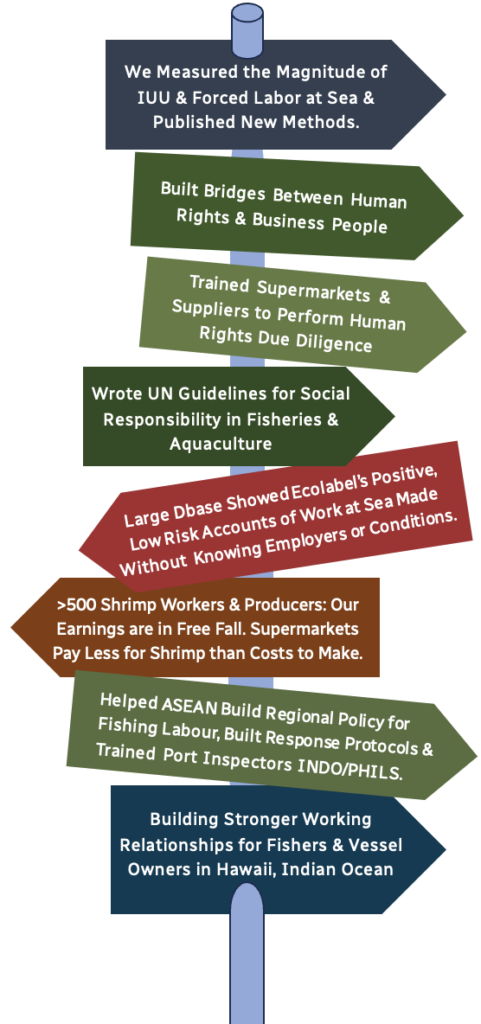
2011-14: Illegal fishing was flagged as a security threat but nobody knew the size or locus of the problem. We estimated its magnitude worldwide by tracing 30 top US seafood imports from 10 countries finding 20-32% average illegal content, 70% Thai tuna. Results: USA struck a Presidential Task Force and began monitoring imports, citing our work 44x.
2013-16: We developed detection methods with Thai Labour Rights Promotion Network we published in Science Advances and screened over 500 supply chains. Results: We introduced Human Rights Due Diligence to the seafood industry and won the Partnership for Freedom grand prize for Labor Safe Screen digital.
2015-2024: We built labour oversight by training (1) 80 seafood suppliers in 14 countries, (2) inspectors at 4 ports in Indonesia and the Philippines, and (3) 6 sectors of employers in Thailand and Indonesia with IOM. We drafted global guidelines for fisheries & aquaculture for UN-FAO. Results: The port protocols were mandated and within 2 months 13 young women were rescued and their traffickers apprehended at General Santos airport.
Pandemic Impacts: We researched rights-washing for Humanity United and the Freedom Fund. First we built a dbase of 3327 vessels fishing for ecolabeled tuna and data showed the MSC ecolabel did not know conditions or employers & most fishers were stranded at sea when it said forced labour risks were lower for certified seafood. Results: Findings in Nature were featured by the Financial Times and Re:Structure Lab. Second we traced wholesale prices, producer and workers’ earnings and costs after recovery in the shrimp sector. Numbers showed blocked recovery, rising unpaid work, price destruction for producers as supermarkets paid less for shrimp than it cost to farm, raised consumer prices. Results: Tough but effective dialogue with Vietnam’s government. Featured by Associated Press in newspapers across Asia, Washington Post, all major US networks.
2025-26: We assisted ASEAN to develop a fishing labour policy and prepared practical workplace tools for workers and employers to use, like a Crew Rights Handbook and Vessel Owner Code of Conduct for the Hawaii Tuna Fleet in Bahasa, Tagalog, English, Vietnamese. We support 2 Fishery Improvement Projects. Results: Regional policy for SE Asian fishers. Stronger working relationships in Hawaii. Lower mortality for sea birds, turtles, sharks.
We invest in long-term stewardship and collaborate with everyone to produce goods and growth durably and with dignity.

About Us
The Sustainability Incubator is a project-based firm embedding stewardship in commodity industries, global supply chains, government policy and mandates. We develop research and tools like the Labour Safe Screen and Live the Code that are highly cited and widely used.
Projects are localized and staffed by resident researchers and leaders. For example, our shrimp field work and interviews were performed in Vietnam by Hanoi-based Center for Development and Integration and International Collaborating Centre for Aquaculture and Fisheries Sustainability with a professor of rural development at a university in southern Viet Nam and Mindanao-based Angel Ysik; in India by the Corporate Accountability Lab; and in Indonesia by the Jakarta-based Institute for Policy Research and Advocacy (ELSAM), Akatiga Center for Social Analysis in Bandung, and the Yogyakarta-based Miganani Research Institute.
The interdisplinary scientist providing the firm’s leadership, practical methods and rigorous science is founder Dr. Katrina Nakamura. Mentored by Dr.s Elinor Ostrom, Petra Clara Arck and Janice Jiggins, Katrina has invested her career in building governance. She is known for her leadership on market measures for sustainability and human rights and is consulted frequently by the Financial Times (1,2), Associated Press (1,2), Washington Post, NPR, and seafood media.
Katrina holds a doctorate in business, stress, risk and impact and an MSc with accreditation in rural planning. Her philosophy of building bridges where bottom-up-meets-top-down in supply chains and governments to her origins in a northern Canadian mining town and early career leadership positions with four co-management boards for public lands and indigenous territories. Katrina co-founded and operated wharfside Café New Orleans and Opa Sushi (5 locations) to feed local fish to the community and co-founded the live-caught Skeena Wild brand of sockeye salmon, the Quality Fishing Expo (Prince Rupert) and the Crew Matters Committee in Honolulu.
Resources to Share
Curricula for Port Inspections to Detect & Respond to Forced Labour:
- International Organization for Migration-Training-Manual-for-Fishing-and-Seafood-Enterprises_Thailand,
- IOM-Training-Manual-for-Fishing-and-Seafood-Enterprises-Indonesia,
- SAFE-Seas-Training-Manual-for-Port-Inspectors-Philippines.
- SAFE-Seas-Training-Manual-for-Port-Inspectors_Indonesia.
- Recent Publications:
- Is tuna ecolabeling causing fishers more harm than good? Nature
- A Practical Take on the Duty to Uphold Rights in the Seafood Workplace. Marine Policy.
- Seeing Slavery in Seafood Supply Chains. Science Advances.
- Committing to Socially Responsible Seafood, Science.
- Social equity is key to sustainable ocean governance. Nature.
- The role of human rights in implementing socially responsible seafood. PloS One.
- Committing to socially responsible seafood. Science.
- Estimates of illegal and unreported fish in seafood imports to the USA Marine Policy.
- Op/Ed: The numbers tell the story when it comes to forced labor in seafood. Seafood Source Media.
- Performance of regional fisheries management organizations: ecosystem‐based governance of bycatch and discards, Fish and Fisheries.
- Improvements to Rapfish: a rapid evaluation technique for fisheries integrating ecological and human dimensions. Journal of Fish Biology.
- Sea turtle bycatch to fish catch ratios for differentiating Hawaii longline-caught seafood products. Marine Policy.
Contact us at the.sustainability.incubator@gmail.com. Mahalo.